When Dashboards Become Distractions: Rethinking How Leaders Consume Information
Dashboards were supposed to make leadership easier. Instead, in many organizations, they’ve made it noisier.
Every function now has one. Sales dashboards. Delivery dashboards. Finance dashboards. HR dashboards. Marketing dashboards. Real-time dashboards. Executive dashboards. AI-enhanced dashboards.
And yet, leaders still walk into meetings asking the same question: “What actually matters here?”
The issue isn’t visibility. It’s interpretation. We have optimized for display, not for decision.
The Dashboard Explosion
Over the past decade, organizations have heavily invested in BI and analytics tools. According to Gartner, analytics adoption across enterprises continues to grow, yet a significant percentage of organizations report that insights fail to meaningfully influence decision-making. Research from McKinsey has similarly shown that while data availability has increased exponentially, decision quality has not improved proportionally.
Why? Because dashboards answer descriptive questions:
- What happened?
- How are we tracking?
- Where are we up or down?
But leaders operate in a different cognitive mode. They are not primarily looking for descriptive clarity. They are looking for directional judgment.
A dashboard presents numbers. A leader must infer meaning. That inference gap is where distraction begins.
The Cognitive Cost of Too Many Metrics
There is a hidden tax in dashboard-driven cultures: cognitive overload.
Harvard Business Review has highlighted that executives today face unprecedented information density, leading to decision fatigue and slower alignment. Behavioural research consistently shows that as choices and variables increase, clarity decreases. More metrics do not necessarily create better decisions; they often create hesitation.
When a leadership team reviews 40 KPIs across functions, what typically happens? The conversation shifts to reconciling numbers. Teams defend variances. Data definitions are debated. The meeting becomes an audit session rather than a strategic dialogue.
Dashboards intended to accelerate alignment end up consuming executive bandwidth. Visibility without synthesis becomes noise.
The Dashboard 2×2: Visibility vs. Relevance
To understand the problem structurally, consider a simple framework.
On one axis lies Visibility — how much data is surfaced. On the other lies Strategic Relevance — how directly that data informs executive decisions.
Many organizations operate in a high-visibility, low-relevance quadrant. They surface vast amounts of information, but much of it lacks direct connection to the decisions at hand. Leaders scroll, scan, and sift — but still ask for “the takeaway.”
Low-visibility, low-relevance environments are clearly underdeveloped. But high-visibility, low-relevance environments are more dangerous. They create the illusion of sophistication while slowing decision velocity.
The only sustainable quadrant is high visibility paired with high relevance — where information is curated, contextualized, and directly linked to strategic questions. The shift required is not technical. It is architectural.
Dashboards Were Built for Operators, Not Orchestrators
Most dashboards were designed to monitor performance, not orchestrate strategy. They are excellent at tracking:
- Revenue trends
- Utilization rates
- Marketing funnel metrics
- Attrition statistics
They are less effective at answering:
- Where are we exposed?
- What external shifts threaten our trajectory?
- Which relationships matter most this quarter?
- Where will friction compound if left unattended?
Operators need metrics. Executives need signal.
When leaders consume operator-grade dashboards without executive-grade synthesis, distraction replaces clarity.
The AI Amplifier Problem
The rise of AI has not automatically solved this issue. In many cases, it has amplified it.
AI can summarize dashboards. It can generate insights. It can highlight anomalies. But if the underlying architecture is fragmented, AI simply accelerates fragmentation. Synthesis layered on siloed metrics remains siloed.
The real opportunity lies not in automating dashboards, but in redesigning how intelligence flows to leadership. Instead of layering AI on top of reporting systems, organizations must rethink what information executives truly need — and in what context.
Technology enhances architecture. It does not compensate for its absence.
From Dashboards to Decision Engines
At Alethic, we believe leaders should not navigate through dashboards. They should operate within decision environments.
A decision environment connects:
- External signals
- Competitive movements
- Account exposure
- Delivery health
- Organizational capability
Instead of reviewing five dashboards across five systems, executives interact with a unified intelligence layer — one that surfaces what matters relative to strategic priorities.
That is the philosophy behind NUDGE. It is not another dashboard stack. It is an Executive Intelligence Engine designed to surface cross-context signal before leaders ask for it.
The difference is subtle but profound. Dashboards show data. Intelligence environments shape judgment.
Rethinking Information Consumption at the Top
If dashboards are becoming distractions, leaders must rethink how information is consumed.
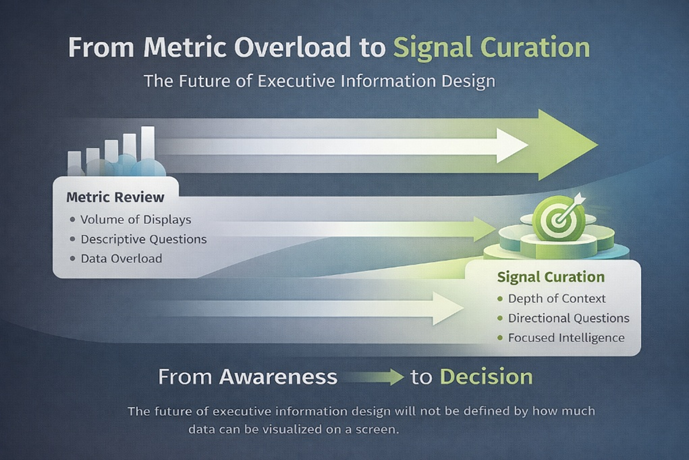
This means shifting from metric review to signal curation. It means asking fewer descriptive questions and more directional ones. It means reducing the volume of displayed data while increasing contextual depth.
It also requires discipline. Not every metric deserves executive attention. Not every fluctuation requires discussion. Leadership time is a scarce strategic resource.
The future of executive information design will not be defined by how much data can be visualized on a screen. It will be defined by how quickly leaders can move from awareness to decision.
The Strategic Question
If your executive dashboards disappeared tomorrow, would strategic clarity improve or deteriorate?
If clarity would improve, you are not under-informed. You are over-instrumented.
In an age of infinite visibility, restraint becomes powerful. Coherence becomes advantage. And signal — properly designed, contextualized, and delivered — becomes the true operating system of leadership.
Dashboards were a necessary evolution. But the next evolution is intelligence architecture. And the organizations that recognize this shift early will move faster, align better, and decide with greater confidence in a world that is only getting noisier.
Want to explore how Alethic can bring intelligence architecture to your organization?